Our Daily Dose
Day 351 of 365 · Week 51 · The Armor of God
◆
The Birth of John the Baptist and the Magnificat
Luke 1:39-56
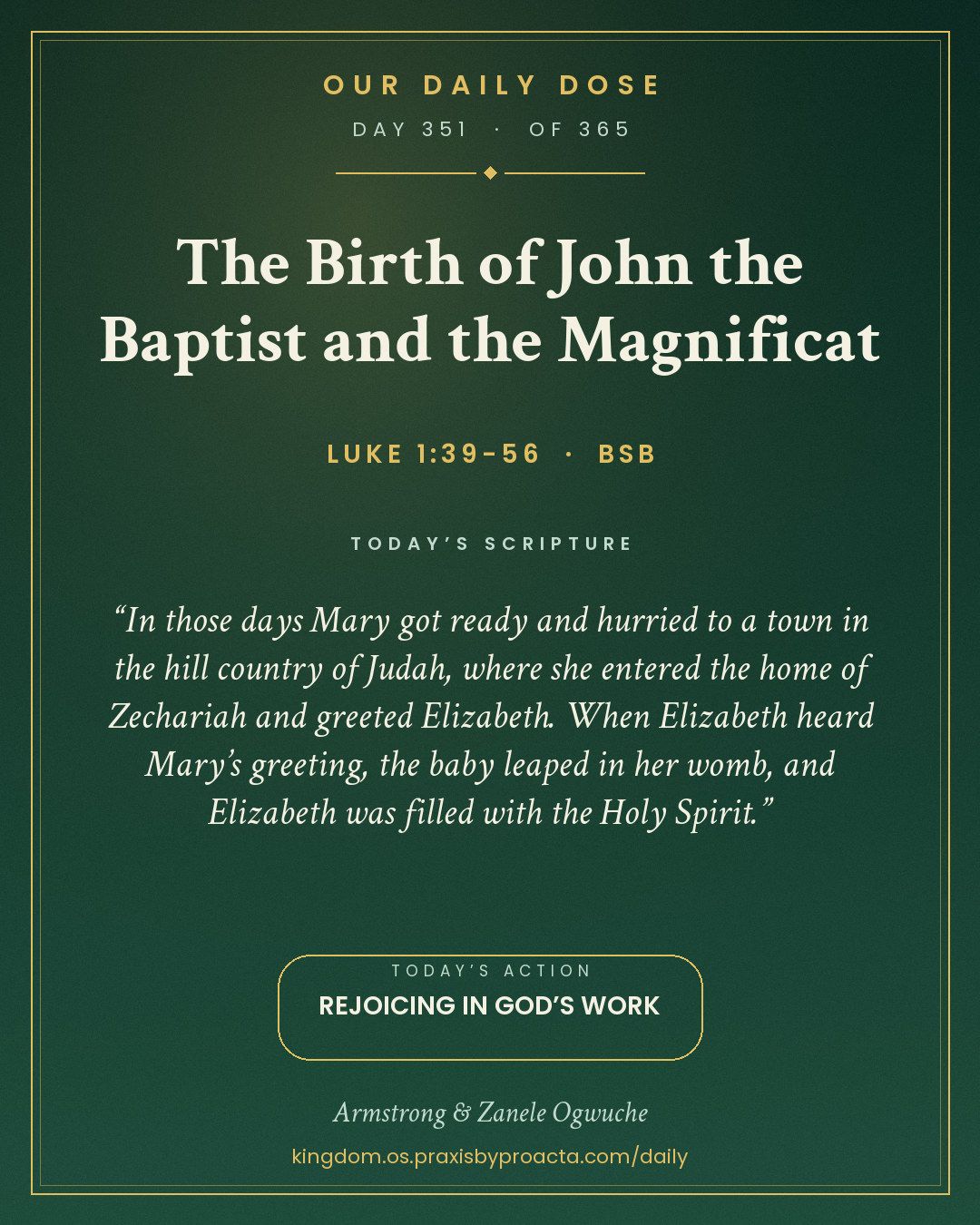
Scripture · Luke 1:39-56
39In those days Mary got ready and hurried to a town in the hill country of Judah, 40where she entered the home of Zechariah and greeted Elizabeth. 41When Elizabeth heard Mary’s greeting, the baby leaped in her womb, and Elizabeth was filled with the Holy Spirit. 42In a loud voice she exclaimed, “Blessed are you among women, and blessed is the fruit of your womb! 43And why am I so honored, that the mother of my Lord should come to me? 44For as soon as the sound of your greeting reached my ears, the baby in my womb leaped for joy. 45Blessed is she who has believed that the Lord’s word to her will be fulfilled.” 46Then Mary said: “My soul magnifies the Lord, 47and my spirit rejoices in God my Savior! 48For He has looked with favor on the humble state of His servant. From now on all generations will call me blessed. 49For the Mighty One has done great things for me. Holy is His name. 50His mercy extends to those who fear Him, from generation to generation. 51He has performed mighty deeds with His arm; He has scattered those who are proud in the thoughts of their hearts. 52He has brought down rulers from their thrones, but has exalted the humble. 53He has filled the hungry with good things, but has sent the rich away empty. 54He has helped His servant Israel, remembering to be merciful, 55as He promised to our fathers, to Abraham and his descendants forever.” 56Mary stayed with Elizabeth for about three months and then returned home.
Berean Standard Bible (BSB), public domain.
Following the Annunciation, Luke’s Gospel continues with the visit of Mary to her relative Elizabeth, the mother of John the Baptist. This section also includes Mary’s song of praise, known as the Magnificat.
Exegesis and Study
- The Joyful Meeting: When Mary visits Elizabeth, the unborn John the Baptist leaps in Elizabeth’s womb, indicating the recognition of Jesus even before His
birth. Elizabeth, filled with the Holy Spirit, blesses Mary and acknowledges the significance of her child, referring to Him as “my Lord.” This encounter emphasizes the joy and recognition of God’s work in bringing about the Messiah.
- Mary’s Magnificat: In response to Elizabeth’s blessing, Mary sings a song of praise, the Magnificat. In this song, Mary glorifies God for His greatness, mercy, and faithfulness. She acknowledges that God has looked with favor on her humble state and that His mercy extends to those who fear Him from generation to generation. The Magnificat echoes themes from the Old Testament, particularly the praise of Hannah in 1 Samuel 2:1-10, and highlights God’s concern for the lowly and His opposition to the proud and powerful.
Practical Application
- Rejoicing in God’s Work: The meeting between Mary and Elizabeth reminds us of the importance of recognizing and rejoicing in God’s work in our lives and the lives of others. We are called to celebrate God’s blessings and to encourage one another in faith.
- Praising God for His Mercy: Mary’s Magnificat encourages us to praise God for His mercy and faithfulness. We are invited to reflect on how God has worked in our lives, lifting up the lowly and fulfilling His promises. Like Mary, we should respond to God’s goodness with heartfelt praise and gratitude.
Prayer Guide
- Pray for a Spirit of Rejoicing: Ask God to help you recognize His work in your life and to rejoice in His
blessings. Pray for a heart that celebrates His goodness and shares that joy with others.
- Pray for a Grateful Heart: Reflect on the ways God has shown you mercy and faithfulness. Pray for a heart of gratitude that responds to God’s work with praise and worship.
This devotional is one day from Our Daily Dose, a 365-day journey through Scripture by Armstrong & Zanele Ogwuche.
Read the full book in the KOS Library →
Read the full book in the KOS Library →
Scripture is shown in public-domain translations, so you can share it freely. The study text is from Our Daily Dose by Armstrong & Zanele Ogwuche.
A daily devotional from KingdomOS. Share freely; every card links back here.
A daily devotional from KingdomOS. Share freely; every card links back here.