The Perseverance of Faith
Hebrews 11:23-40
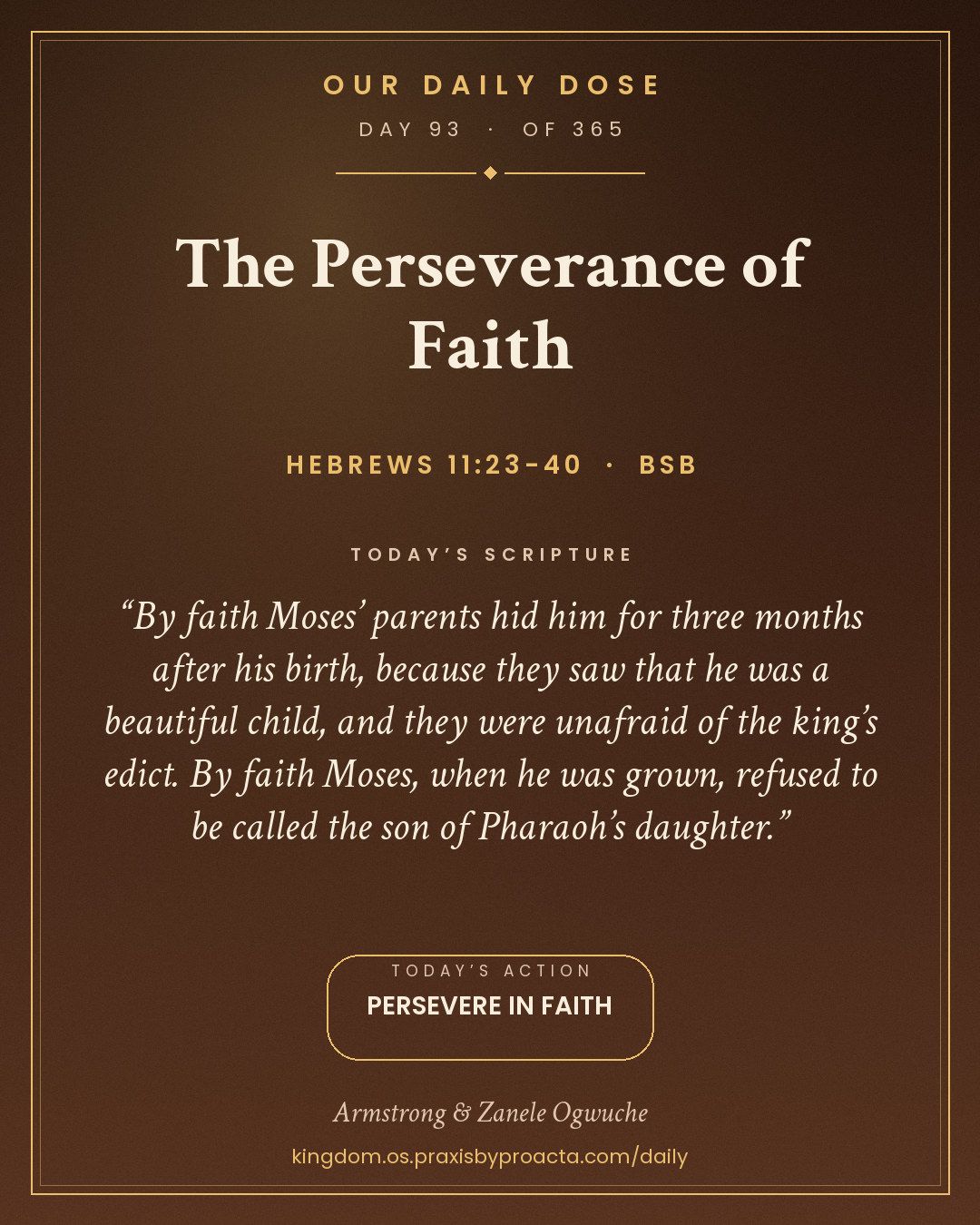
Scripture · Hebrews 11:23-40
Berean Standard Bible (BSB), public domain.
The latter part of Hebrews 11 focuses on the perseverance of faith, highlighting figures such as Moses, the Israelites, Rahab, and others who endured trials and hardships because of their faith in God.
- Moses’ Faith: “By faith Moses’ parents hid him for three months after he was born, because they saw he was no ordinary child, and they were not afraid of the king’s edict” (Hebrews 11:23). Later, Moses himself is commended for choosing to identify with the people of God rather than enjoy the fleeting pleasures of sin in Egypt. Moses’ faith is characterized by his willingness to forsake earthly power and wealth for the sake of God’s calling.
- The Israelites’ Faith: The faith of the Israelites is highlighted in their crossing of the Red Sea and their conquest of Jericho. These events demonstrate the collective faith of a people who trusted in God’s deliverance and followed His instructions, even when the outcome was uncertain.
- Rahab’s Faith: Rahab, a prostitute in Jericho, is commended for her faith in welcoming the Israelite spies and helping them escape. Her faith led to her and her family’s salvation when Jericho was destroyed. Rahab’s inclusion in this list underscores that faith is accessible to all, regardless of background or past actions.
The chapter concludes with a summary of various other heroes of faith, some of whom experienced miraculous deliverance, while others endured persecution, suffering, and even death. The writer of Hebrews notes that “these were all commended for their faith, yet none of them received what had been promised, since God had planned something better for us so that only together with us would they be made perfect” (Hebrews 11:39-40).
Exegetical Viewpoints
- Faith in the Face of Suffering: The examples of Moses, the Israelites, and the unnamed heroes of faith emphasize that faith often involves enduring suffering and hardship for the sake of God’s promises. Faith is not a guarantee of an easy life; rather, it is the confidence that God is with us in the midst of trials and that His promises are worth enduring for.
- The Incomplete Fulfillment: The idea that the heroes of faith did not receive the full fulfillment of the promises in their lifetimes points to the future hope of the coming of Christ. Their faith was forward-looking, anticipating the fulfillment of God’s redemptive plan, which has now been revealed in Jesus Christ.
Practical Applications
- Persevere in Faith: When you face trials, difficulties, or persecution, remember the examples of those who endured through faith. Let their perseverance inspire you to remain steadfast, knowing that God is faithful and
that the rewards of faith far outweigh the temporary challenges.
- Look Forward to the Fulfillment of God’s Promises: Keep your eyes fixed on the ultimate fulfillment of God’s promises in Christ. Live with the hope that, like the heroes of faith, you are part of a greater story that culminates in the return of Christ and the establishment of His kingdom. Conclusion: New Testament Faith Hebrews 11 is a powerful testament to the enduring and transformative nature of faith. Through the examples of the patriarchs, prophets, and other heroes of faith, we see that faith is not a passive belief but an active, living trust in God that shapes every aspect of our lives. These individuals demonstrated that faith involves obedience to God’s commands, perseverance through trials, and confidence in God’s promises, even when those promises are not immediately fulfilled. The chapter also highlights the diversity of faith experiences—from miraculous deliverance to enduring suffering and martyrdom—showing that faith takes many forms but always centers on a deep trust in God’s character and His ultimate plan. The heroes of faith were commended not because their lives were easy or because they saw all of God’s promises come to fruition in their lifetimes, but because they trusted in God and lived their lives in light of His promises. As we reflect on Hebrews 11, we are reminded that we are part of this great cloud of witnesses. Their stories are not just historical accounts but living testimonies that encourage us
to walk in faith today. We are called to take up the mantle of faith, to live with the same confidence in God’s promises, and to persevere in our journey, knowing that our faith connects us to God’s overarching redemptive plan. May the examples of faith found in Hebrews 11 inspire us to deepen our trust in God, to live out our faith with courage and conviction, and to keep our eyes fixed on Jesus, “the pioneer and perfecter of faith” (Hebrews 12:2). In doing so, we participate in the unfolding of God’s promises and bear witness to the power of faith in the New Testament and in our own lives today.
April Grace and Forgiveness
Theme: Experiencing and extending God’s grace and forgiveness. Week 16: Day 94-100 Grace in the Old Testament
The concept of grace is often associated with the New Testament, particularly with the teachings of Jesus and the writings of Paul. However, the Old Testament is also rich with examples of God’s grace—His unmerited favor and love extended to humanity. In Week 16, we will explore two significant narratives in the Old Testament: the story of Noah in Genesis 6:1-9 and the encounter between God and Moses in Exodus 34:1-7. These passages reveal that God’s grace has been present and active since the beginning of creation, offering hope and redemption even in the face of human sinfulness.
Read the full book in the KOS Library →
A daily devotional from KingdomOS. Share freely; every card links back here.