Our Daily Dose
Day 354 of 365 · Week 51 · The Armor of God
◆
The Visit of the Magi
Matthew 2:1-12
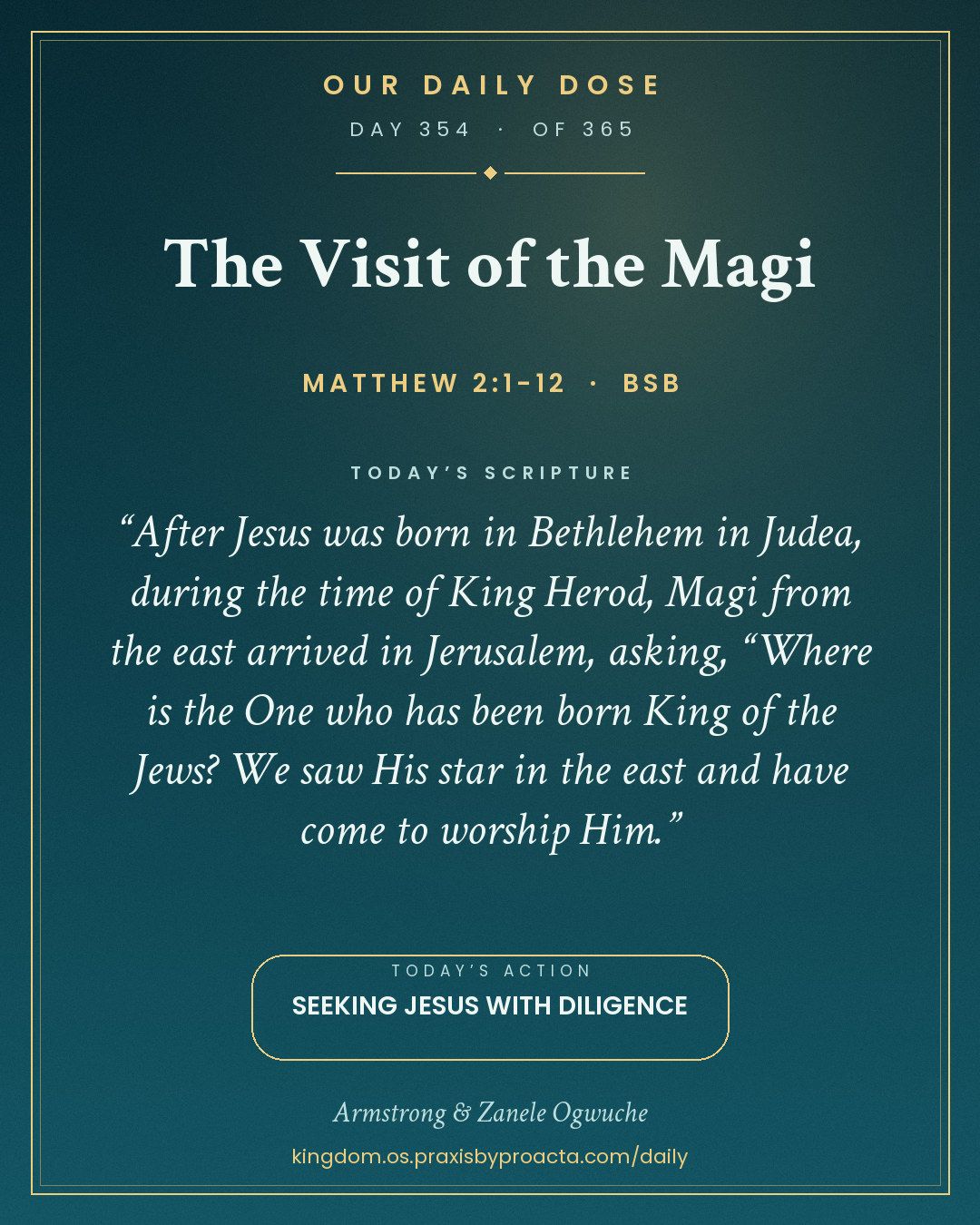
Scripture · Matthew 2:1-12
1After Jesus was born in Bethlehem in Judea, during the time of King Herod, Magi from the east arrived in Jerusalem, 2asking, “Where is the One who has been born King of the Jews? We saw His star in the east and have come to worship Him.” 3When King Herod heard this, he was disturbed, and all Jerusalem with him. 4And when he had assembled all the chief priests and scribes of the people, he asked them where the Christ was to be born. 5“In Bethlehem in Judea,” they replied, “for this is what the prophet has written: 6‘But you, Bethlehem, in the land of Judah, are by no means least among the rulers of Judah, for out of you will come a ruler who will be the shepherd of My people Israel.’” 7Then Herod called the Magi secretly and learned from them the exact time the star had appeared. 8And sending them to Bethlehem, he said: “Go and search carefully for the Child, and when you find Him, report to me, so that I too may go and worship Him.” 9After they had heard the king, they went on their way, and the star they had seen in the east went ahead of them until it stood over the place where the Child was. 10When they saw the star, they rejoiced with great delight. 11On coming to the house, they saw the Child with His mother Mary, and they fell down and worshiped Him. Then they opened their treasures and presented Him with gifts of gold and frankincense and myrrh. 12And having been warned in a dream not to return to Herod, they withdrew to their country by another route.
Berean Standard Bible (BSB), public domain.
The visit of the Magi, or wise men, is another significant event in the Nativity story. Their journey to find and worship the newborn King illustrates the recognition of Jesus’ kingship by the nations and the fulfillment of prophecies.
Exegesis and Study
- The Magi’s Journey: The Magi, often described as wise men or kings, came from the East, likely from regions such as Persia or Babylon. Their journey to find the “king of the Jews” demonstrates the fulfillment of the prophecy that nations would come to the light of the Messiah (Isaiah 60:1-3). The star they followed was a divine sign guiding them to the true King.
- Gifts Fit for a King: The gifts of gold, frankincense, and myrrh presented by the Magi have symbolic meanings:
- Gold represents Jesus’ kingship and divinity.
- Frankincense symbolizes worship and prayer, acknowledging Jesus’ priestly role.
- Myrrh is a foreshadowing of Jesus’ suffering and death, as it was commonly used for embalming.
- The Contrast with Herod: King Herod’s reaction to the news of Jesus’ birth is one of fear and hostility. Unlike the Magi, who seek to worship the new King, Herod sees Jesus as a threat to his power and plots to kill Him. This contrast highlights the differing responses to Jesus’ kingship—one of worship and reverence, and the other of rejection and opposition.
Practical Application
- Seeking Jesus with Diligence: The Magi’s journey shows their commitment to seeking and worshiping Jesus, despite the difficulties and distance they faced. We are encouraged to seek Jesus with the same diligence and devotion, making Him the center of our lives and worship.
- Offering Our Best to Jesus: The gifts of the Magi remind us to offer our best to Jesus, recognizing His kingship and divinity. We are called to give Him the best of our time, talents, and resources, as an act of worship and devotion.
Prayer Guide
- Pray for a Heart to Seek Jesus: Ask God to give you a heart that seeks Him diligently, like the Magi. Pray for the desire to pursue a deeper relationship with Jesus and to make Him the priority in your life.
- Pray for a Generous Spirit: Reflect on the gifts the Magi offered to Jesus. Pray for a generous spirit that is willing to give your best to God, in gratitude for His love and grace.
This devotional is one day from Our Daily Dose, a 365-day journey through Scripture by Armstrong & Zanele Ogwuche.
Read the full book in the KOS Library →
Read the full book in the KOS Library →
Scripture is shown in public-domain translations, so you can share it freely. The study text is from Our Daily Dose by Armstrong & Zanele Ogwuche.
A daily devotional from KingdomOS. Share freely; every card links back here.
A daily devotional from KingdomOS. Share freely; every card links back here.