Honoring All Parts of the Body
1 Corinthians 12:15-26
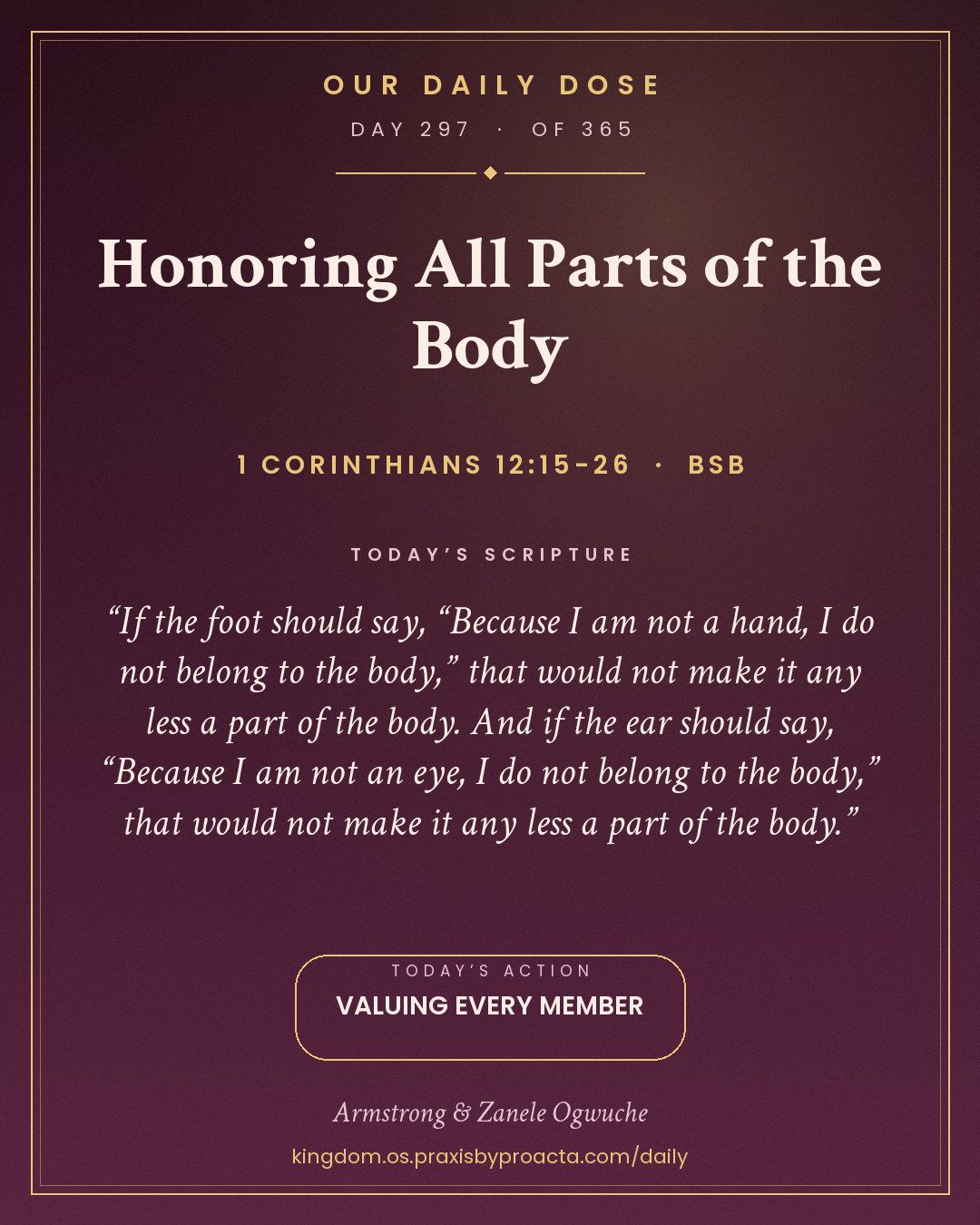
Scripture · 1 Corinthians 12:15-26
Berean Standard Bible (BSB), public domain.
Paul continues his analogy of the body by addressing the potential for division within the Church based on the perceived importance of different gifts. He emphasizes that no part of the body can say to another, “I don’t need you,” and that those parts of the body that seem weaker or less honorable are actually indispensable and deserving of special honor.
- “Now if the foot should say, ‘Because I am not a hand, I do not belong to the body,’ it would not for that reason stop being part of the body. And if the ear should say, ‘Because I am not an eye, I do not belong to the body,’ it would not for that reason stop being part of the body. If the whole body were an eye, where would the sense of hearing be? If the whole body were an ear, where would the sense of smell be? But in fact God has placed the parts in the body, every one of them, just as he wanted them to be.”
- “If they were all one part, where would the body be? As it is, there are many parts, but one body. The eye
cannot say to the hand, ‘I don’t need you!’ And the head cannot say to the feet, ‘I don’t need you!’ On the contrary, those parts of the body that seem to be weaker are indispensable, and the parts that we think are less honorable we treat with special honor. And the parts that are unpresentable are treated with special modesty, while our presentable parts need no special treatment. But God has put the body together, giving greater honor to the parts that lacked it, so that there should be no division in the body, but that its parts should have equal concern for each other. If one part suffers, every part suffers with it; if one part is honored, every part rejoices with it.”
Exegesis and Study
- The Importance of Every Member: Paul emphasizes that every part of the body is essential, regardless of its perceived strength or visibility. Just as every organ and limb in the human body has a unique function, every member of the Church has a role that is indispensable to the overall health of the body of Christ. This teaching corrects the tendency to undervalue certain gifts or roles in the Church and promotes an attitude of mutual respect and honor.
- Interconnectedness and Mutual Care: Paul’s analogy underscores the interconnectedness of the body of Christ. When one part of the body suffers, the whole body is affected, and when one part is honored, the entire body shares in that joy. This reflects the profound unity that should characterize the Church—a unity that goes beyond mere cooperation and reaches into the very heart of what it means to be a community in Christ.
Practical Application
- Valuing Every Member: Paul’s teaching challenges us to value every member of the Church, regardless of their role or the visibility of their gifts. This means affirming the contributions of those whose work may go unnoticed and treating each person with honor and respect. We should seek to create a Church culture where every gift and role is recognized as vital to the mission of the body.
- Cultivating Mutual Care: The principle that “if one part suffers, every part suffers with it” calls us to cultivate deep mutual care within the Church. We are to be attentive to the needs of others, offering support and encouragement in times of difficulty, and celebrating together when members of the body experience success or honor. This mutual care fosters a sense of belonging and strengthens the unity of the Church.
Prayer Guide
- Pray for a Heart that Values Every Member: Ask God to help you value and honor every member of the Church, regardless of their role or gift. Pray for the grace to affirm the contributions of others and to encourage a culture of respect and honor within the body of Christ.
- Pray for Mutual Care and Unity: Reflect on the interconnectedness of the body of Christ. Pray for a heart that is sensitive to the needs of others and willing to share in their joys and sorrows. Ask God to help you contribute to the unity and mutual care of the Church.
Read the full book in the KOS Library →
A daily devotional from KingdomOS. Share freely; every card links back here.