Our Daily Dose
Day 234 of 365 · Week 34 · The Wisdom of Jesus
◆
Honoring the Weaker Parts
1 Corinthians 12:21-26
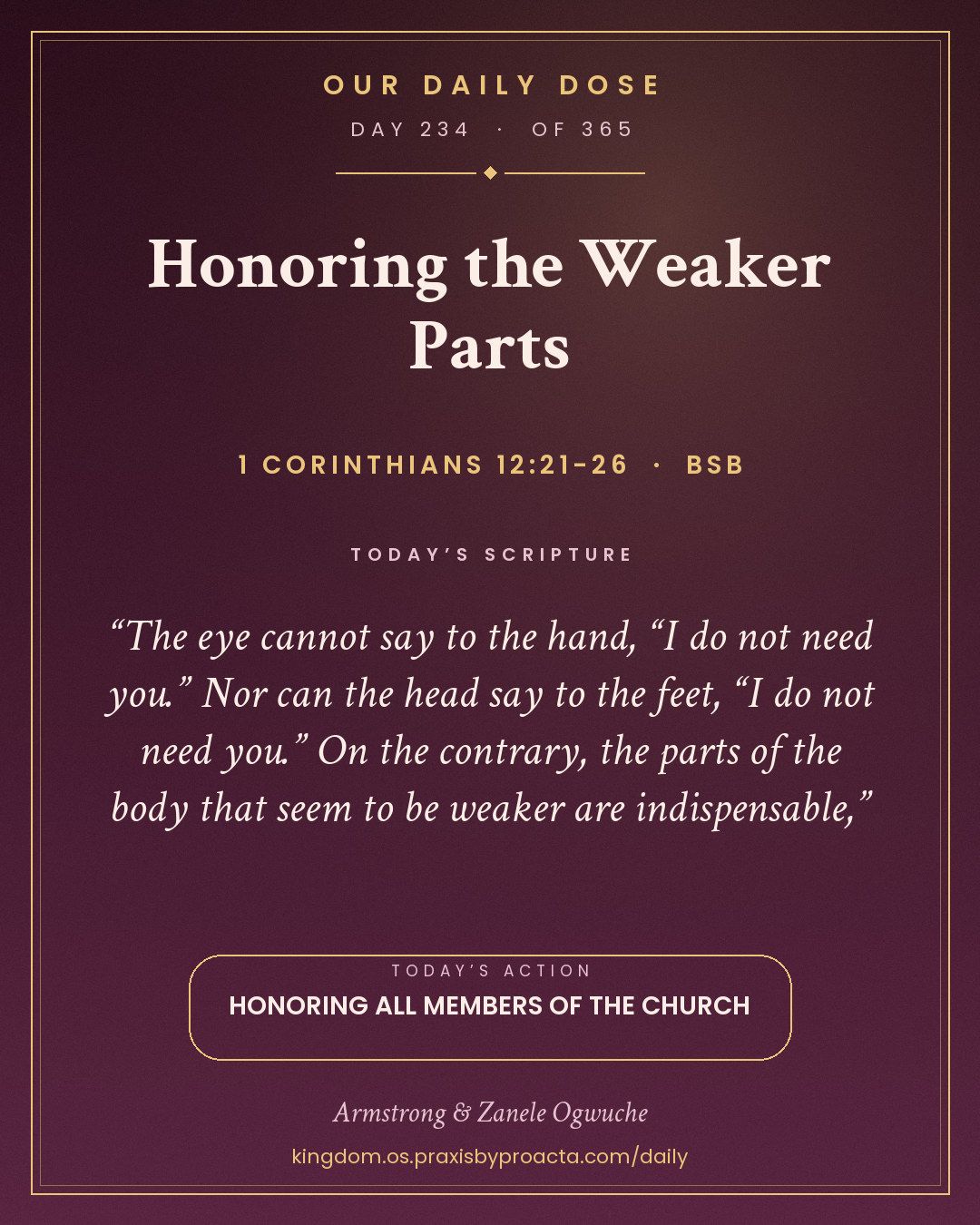
Scripture · 1 Corinthians 12:21-26
21The eye cannot say to the hand, “I do not need you.” Nor can the head say to the feet, “I do not need you.” 22On the contrary, the parts of the body that seem to be weaker are indispensable, 23and the parts we consider less honorable, we treat with greater honor. And our unpresentable parts are treated with special modesty, 24whereas our presentable parts have no such need. But God has composed the body and has given greater honor to the parts that lacked it, 25so that there should be no division in the body, but that its members should have mutual concern for one another. 26If one part suffers, every part suffers with it; if one part is honored, every part rejoices with it.
Berean Standard Bible (BSB), public domain.
Paul continues his metaphor of the body by addressing the tendency to value certain parts more than others. He argues that even the parts of the body that seem weaker or less honorable are indispensable and should be treated with special honor and care.
Exegesis and Study
- Valuing Every Member: Paul challenges the Corinthian church, and by extension all believers, to reexamine how they value different members of the body. In the human body, every part has a purpose, and even those parts that seem weaker or less visible are vital to the body’s overall function. Similarly, in the Church, those who might
be considered less significant or who serve in less visible roles are nonetheless indispensable.
- God’s Design for the Body: Paul emphasizes that God has arranged the body in such a way that the parts that seem weaker or less honorable are given greater honor. This is a powerful reminder that God’s values often differ from human values. In God’s economy, every person has inherent worth and is deserving of respect and honor, regardless of their role or status within the Church.
Practical Application
- Honoring All Members of the Church: Practically, this teaching calls us to honor and respect all members of the Church, especially those who might be overlooked or undervalued. This might involve recognizing and affirming the contributions of those who serve behind the scenes, ensuring that everyone feels valued and included, and offering special care and support to those who are struggling or vulnerable.
- Cultivating a Culture of Honor: Creating a culture of honor within the Church means intentionally valuing each person’s contributions and treating everyone with dignity and respect. This can be expressed through words of encouragement, acts of service, and a willingness to listen and learn from others, regardless of their position or role.
Prayer Guide
- Pray for a Heart That Honors Others: Ask God to give you a heart that honors and values others, especially those who may be overlooked or undervalued. Pray for the
ability to see people as God sees them and to treat them with the respect and dignity they deserve.
- Pray for the Church to Reflect God’s Values: Reflect on how your church or community values different roles and members. Pray for a culture of honor that reflects God’s values, where every person is recognized as indispensable and treated with the love and respect that God desires for His people. Pray that your church would be a place where everyone feels valued and where the contributions of all members are celebrated, regardless of their visibility or perceived importance.
This devotional is one day from Our Daily Dose, a 365-day journey through Scripture by Armstrong & Zanele Ogwuche.
Read the full book in the KOS Library →
Read the full book in the KOS Library →
Scripture is shown in public-domain translations, so you can share it freely. The study text is from Our Daily Dose by Armstrong & Zanele Ogwuche.
A daily devotional from KingdomOS. Share freely; every card links back here.
A daily devotional from KingdomOS. Share freely; every card links back here.