The Elder Son’s Response and the Call to Grace
Luke 15:25-32
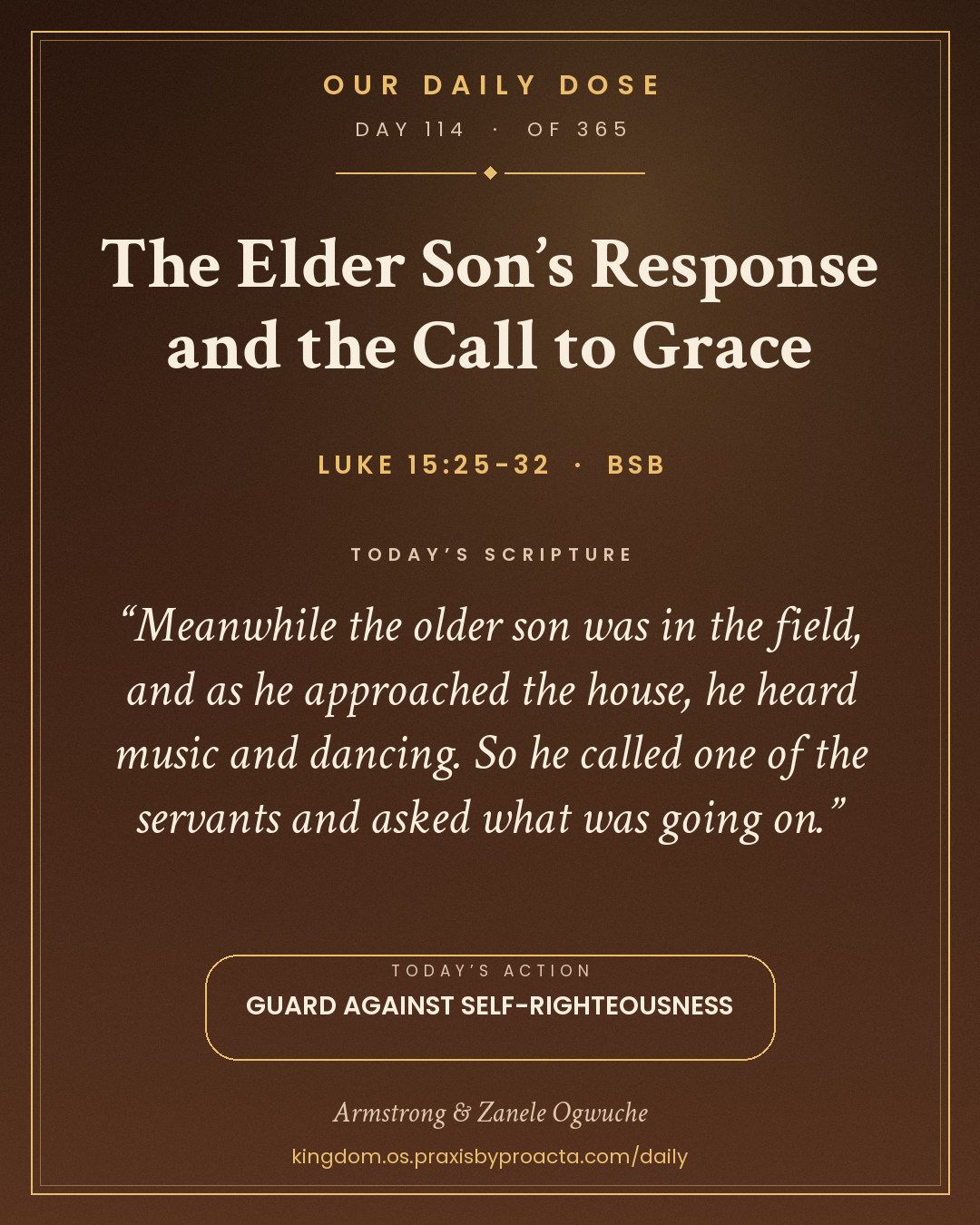
Scripture · Luke 15:25-32
Berean Standard Bible (BSB), public domain.
The parable of the Prodigal Son concludes with the reaction of the elder son, who becomes angry and refuses to join the celebration for his younger brother’s return. The elder son, who has stayed home and faithfully served his father, feels resentful that his wayward brother is being honored with a feast. He confronts his father, expressing his frustration: “Look! All these years I’ve been slaving for you and never disobeyed your orders. Yet you never gave me even a young goat so I could celebrate with my friends. But when this son of yours who has squandered your property with prostitutes comes home, you kill the fattened calf for him!” (Luke 15:29-30). The father gently responds to his elder son, saying, “My son, you are always with me, and everything I have is yours. But we had to celebrate and be glad, because this brother of yours was dead and is alive again; he was lost and is found” (Luke 15:31-32).
Exegetical Viewpoints
- The Elder Son’s Resentment: The elder son’s response reveals a self-righteous attitude that contrasts sharply with the grace and forgiveness shown by the father. The elder son views his relationship with his father in terms
of merit and reward, failing to understand that his father’s love and grace are not transactional. His resentment highlights the danger of legalism, where obedience becomes a means of earning favor rather than a response to love.
- The Father’s Compassion: The father’s response to the elder son is filled with compassion and reassurance. He acknowledges the elder son’s faithfulness and assures him of his place in the family, but he also emphasizes the necessity of celebrating the return of the lost brother. This underscores the father’s (and thus God’s) deep desire for reconciliation and the restoration of relationships.
Practical Applications
- Guard Against Self-Righteousness: Reflect on your own attitudes toward those who have strayed from the faith or made mistakes. Like the elder son, it can be easy to fall into the trap of self-righteousness, believing that your own faithfulness or obedience entitles you to more of God’s favor. Instead, embrace the understanding that God’s grace is freely given to all, and rejoice in the restoration of others.
- Celebrate Others’ Success and Restoration: Learn to genuinely celebrate when others receive blessings, forgiveness, or restoration. Resist the urge to compare your situation with theirs or to harbor resentment. Instead, join in the joy of seeing someone return to God and be restored to the community of faith. Conclusion: Parables of Grace in Luke 15 The parables of the Lost Sheep, the Lost Coin, and the Prodigal Son in Luke 15 are profound illustrations of God’s grace, each highlighting a different aspect of how God
pursues, values, and rejoices over the lost. These stories collectively demonstrate that grace is not something to be earned or deserved but is a gift freely given by a loving God who desires reconciliation and restoration. The parables also challenge us to reflect on our own attitudes toward grace. Are we like the shepherd who tirelessly searches for the lost sheep, or like the elder son who resents the grace extended to others? Are we willing to embrace God’s grace for ourselves and extend it to others, or do we hold onto grudges and self-righteousness? As we conclude this week’s study, let us be inspired by the grace depicted in these parables. May we be people who seek out the lost, celebrate their return, and rejoice in the abundant grace of God that is available to all. Let these stories remind us that no one is beyond the reach of God’s love and that every return to Him is a cause for great joy in heaven.
Week 19: Day 115-121 Jesus and the Adulterous Woman The story of Jesus and the adulterous woman in John 8:1-11 is one of the most powerful narratives in the New Testament that illustrates the themes of mercy, forgiveness, and the radical grace of Jesus Christ. This passage provides a profound example of how Jesus responds to sin, judgment, and hypocrisy, offering mercy in place of condemnation. Over the course of this week, we will delve into this encounter, exploring the context, the implications of Jesus’ actions, and what this story teaches us about mercy and forgiveness in our own lives.
Read the full book in the KOS Library →
A daily devotional from KingdomOS. Share freely; every card links back here.